Alan Michelson’s “The Oyster” Transforms Governors Island’s Waterfront
Jun 10, 2026 3:00 pm
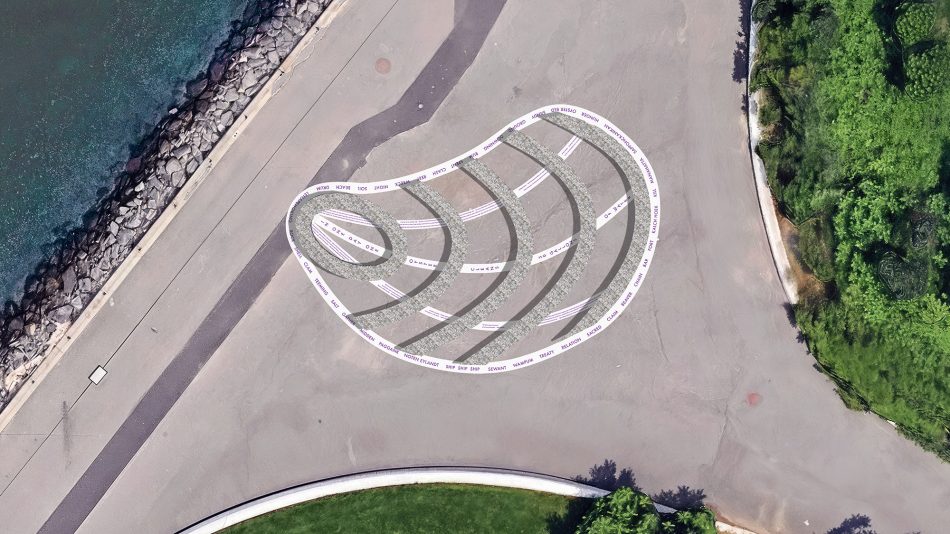
A new sculptural installation commissioned by More Art in partnership with the Billion Oyster Project and Governors Island Arts
On View: July 30 – November 30, 2026 • Western Promenade, Governors Island, New York
More Art is thrilled to announce the opening of The Oyster, a monumental outdoor sculptural commission by internationally recognized Mohawk artist Alan Michelson (Six Nations of the Grand River). The work will be on view on Governors Island from July 30 through November 30, 2026.
Presented as part of More Art’s 2026 initiative Reframing 1776: Land, Water, and the Work of Repair, The Oyster responds to the nation’s 250th anniversary through Indigenous perspectives and environmental histories. Developed in partnership with Billion Oyster Project, and co-presented by Governors Island Arts, the installation references pre-colonial Lenape oyster middens — vast accumulations of shells reflecting long histories of habitation, stewardship, and reciprocal relationship in the region.
Part landform, part amphitheater, The Oyster invites visitors to gather within and around the work and to reflect on the interwoven histories of extraction, trade, nourishment, displacement, and environmental change embedded in the harbor itself. The piece recalls Indigenous geoglyphs and shaped shell middens, while its construction draws directly on the logic of reef building, in particular the gabion and recycled-shell structures employed by Billion Oyster Project.
Encircling the sculpture, a large-scale text installation painted in purple and white gathers reflections on oysters drawn from literature, history, ecology, and popular culture. The text also incorporates contributions from students at New York Harbor School and members of the Governors Island community, while the painted text’s palette references wampum — shell beads historically used by Lenape and other Eastern Woodlands nations in sacred cultural exchanges.
Following the project’s close, elements of the sculpture will be returned to New York Harbor as part of local reef restoration efforts, extending the life of the artwork as living marine infrastructure. The Oyster asks us to engage with the parallel erasures of Indigenous lifeways and oyster ecologies in the harbor, while pointing toward the possibility of restoration and renewal.
About the Artist
Alan Michelson is a celebrated New York-based Mohawk artist, curator, writer, and member of Six Nations of the Grand River. For more than three decades, he has created site-responsive works in sculpture, video, installation, and public art that engage place, memory, and suppressed histories through both Indigenous and Western cultural forms.
The Knowledge Keepers, his acclaimed major public commission, stands at the Huntington Avenue entrance of the Museum of Fine Arts, Boston. Other current projects include Hanödaga:yas (Town Destroyer): Reflect at the new Princeton University Art Museum. Major public works include Mantle (2018), a permanent monument honoring Virginia’s Native nations located on the grounds of the Thomas Jefferson-designed Virginia State Capitol in Richmond.
His writings have appeared in Aperture, Frieze, and October, and his work was recently featured on Art21. His work is held in the collections of the Whitney Museum of American Art, the Smithsonian American Art Museum, and the National Gallery of Canada, among others. Michelson is co-founder and co-curator of Indigenous New York, the influential series organized with the Vera List Center for Art and Politics.
Land Acknowledgement
We acknowledge that The Oyster is situated on Paggank (“Nut Island”), now known as Governors Island, within Lenapehoking, the ancestral homeland of the Lenape people, whose connections to the waters of New York Harbor extend deep into the past.
Oysters and their shells were an important part of Lenape culture, and the shell middens once found throughout the area attest to generations of Indigenous presence and relationships with these waters. Formed through the accumulation of shells over time, these middens embodied longstanding relationships between Indigenous communities and the living abundance of the harbor — relationships profoundly disrupted by colonization.
By returning attention to the oyster as both ecological engineer and cultural anchor, The Oyster invites reflection on histories embedded in the harbor landscape and on the Indigenous communities whose connections to these waters continue today.