Governors Island Arts Presents Bahar Behbhani’s DAMASK ROSE: A GATHERING, Part of Its INTERVENTIONS Series, May 16
May 14, 2026 10:17 am
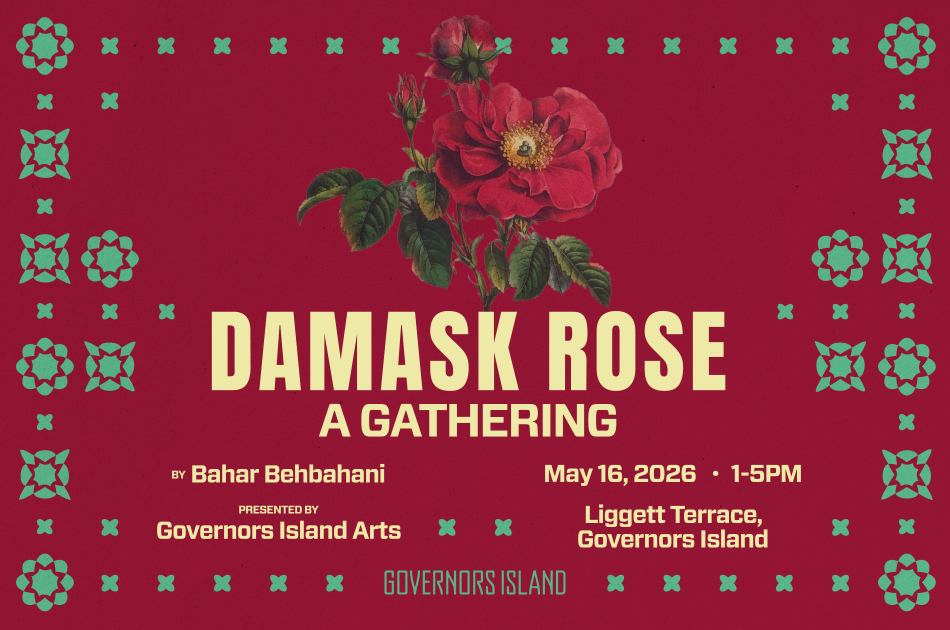
A celebration structured around the ethos of the Persian Garden, with music, performance, storytelling, food, and beverage unfolding across three “pools”, Damask Rose offers a methodology of care in a time of grief
Governors Island Arts, the public arts and cultural program presented by the Trust for Governors Island, presents Damask Rose: A Gathering, a spring celebration created by artist Bahar Behbahani, May 16 from 1 – 5pm in Liggett Terrace on Governors Island. Inspired by the traditions of Persian Garden, the work centers Damask Rose, an immigrant flora from the East, and honors migration and hospitality. Guided by conceptual ideas of shade, wind, immigrant flora, and diasporic ecological and ancestral knowledge, this gathering brings together nonprofit organizations, food and drink storytellers, herbalists, tea practitioners, musicians, and many other like-minded communities and partners to share a moment of joy and resilience.
Damask Rose entwines two of Behbahani’s long-gestating creative and personal desires. The artist whose research-based practice approaches landscape as a metaphor for politics and poetics had long wanted to build a Persian garden in New York as a reclamation from Western romanticization — emphasizing the tradition’s intricate engineering, horticultural wisdom, and spiritual foundations. As an immigrant who came to the country knowing no one over two decades ago, Behbahani has likewise aspired to throw a giant party to bring together the communities that have since become her own. When Governors Island Arts engaged her for its annual INTERVENTIONS performance series, she saw an opportunity to symbolically unite these two ideas.
She says, “I thought my voice itself is not enough: I’ve always wanted to invite people whose work I admire into my home, to cook, read, play, and talk together, the way we do back home. But here, no one seems to have the time to live that way. This project felt like the time I could use to invite other organizations and other voices to cook this with me and bring their own knowledge holder communities and radiant ideas. I really get energy from all these partners who got excited and brought their communities into it and went so far beyond the provision of resources. We put hours and hours of work into it; even a temporary gathering can have a lasting impact.”
On the repurposed former military post-turned lush site of art and exchange, she similarly creates a site of celebration and welcome against a backdrop of war and militarized immigration enforcement. Reflecting the philosophy of interconnected pools in Persian Gardens, Behbahani creates three stages that will be simultaneously and consistently activated throughout the four-hour event.
Loosely, one “pool” will center music and beverage: with an Afropolka collaboration bringing together Cameroonian singer Kaïssa Doumbè, Gambian/Senegalese kora player Malang Jobarteh, and Polish drummer Maciek Schejbal (1 – 2pm); Movement & Flower Muses, goddess making using Japanese paper and paint from matcha, turmeric, and hibiscus, with Kaoru Shimizu and Milād (1 – 2pm); an auditory experience from SAG Radio/Sasan Oskouei highlighting mixes from Iranian and South West Asian and North African (SWANA) artists (2 – 3pm); The Forbidden Spirit, an event from SAG NYC surrounding Aragh Sagi, the raisin-based distilled spirit from Iran, long banned but still present in underground culture (3 – 4pm); and music from Imal Gnawa, the ensemble combining the deep spiritual and rhythmic legacy of Moroccan Gnawa music and bold futurism, and others associated with Barzakh Café (4 – 5pm).
The second “pool” will be a site of discussion and reflection, featuring Talking Peers: Tea as Vessel, a tea-sharing activation from Asia Contemporary Art Forum (ACAF) (1 – 2:15pm); Braiding Resistance, a hair-braiding and knitting event from New York Kurdish Cultural Center with a reading by Kurdish poet Sama Ali (1:45 – 2:30pm); and Hikayat: Dreamweaving, an event from ArteEast bringing together artists and special guests for a collective discussion weaving together a tapestry of history, memory, and survival, rooted in a sensory exploration through the vessel of the Damask Rose (2:30 – 4pm).
Another “pool” will feature engagements for kids and parents: The Reconstruction of (WE): Botanical Cyanotype, a workshop highlighting the biodiversity of trees on Governors Island with Natalia Nakazawa (1 – 2:30pm); a weaving workshop that considers the immediate realities of displacement and what people carry with them when they’re uprooted, with Cynthia Alberto (1 – 2:30pm); The Daughter of Api, an interactive experience from Pardis for Children engaging kids in a collective rain-summoning ritual (2:30 – 4pm); and Eight-Treasure Tea Kids Circle, an opportunity for kids to look, smell, touch, and taste the ingredients originated along the ancient Silk Road, from Tea Arts & Culture (4 – 5pm).
Linking these areas are pathways of greenery that will be periodically activated throughout the day, featuring tea and curated sweets from Eat Offbeat; also from Eat Offbeat, Samanak: A Ritual of Sweetness and Strength with the Afghan women community; offerings of raisins and grapes from Milād; Hafez with setar performed by Mani Nilchiani, alongside recitations by Shamsy Behbahani; From Seed to Sip, a planting workshop focusing on the ancient roots of Sekanjabin in Persian culture from Hortus Life & Jabin Beverage Company (1 – 2:30pm); and, also from Hortus Life, a live floral demonstration, inviting the community to engage with the rose as both a cultural symbol and a living, seasonal presence (3 – 4:30pm). Learn more and reserve free tickets online at www.govisland.org.
The “pools” are outlined by handwoven carpets from across Iran, Morocco, and Afghanistan, with generous support of Kermanshah Rugs. Interspersing them Behbahani has crafted shade-giving structures using crochet woven by her mother Shamsy Behbahani—along with Pooran Shams, Fazilat Hakimzadeh, Mehrnoush Jelveh, Irandokht Farjad, Shahin Mazid-Abadi, and Abbas & Nikoo Afshar—over the last tumultuous months of protests, government repression, and the intense bombardment of the US-Israeli war on Iran.
“I look at the event as if it’s the crochet my mother and her community wove together,” says the artist. “How can I weave us together? I didn’t want a ‘performance.’ I wanted to feel like we’re going to my Uncle’s house and someone knows how to play something, and someone sings, and someone serves tea. In a moment of such heavy grief, I thought the party could be one where we get together as a method of care and hospitality.”
The Damask Rose — a resistant flower from arid regions like modern-day Syria and Iran that has over centuries become a global commodity as well as part of many cultures’ culinary traditions — emerges as a recurring symbol across the event’s many threads.
Damask Rose is part of this year’s INTERVENTIONS series, Governors Island Arts’ multidisciplinary performance series curated by Juan Pablo Siles, Associate Curator and Producer at the Trust for Governors Island. INTERVENTIONS presents local, national, and international artists and invites audiences to experience work made and adapted for the immediate environment. The series will continue June 19 & 20 with Okwui Okpokwasili and Peter Born’s collaborative performing arts practice Sweat Variant bringing to Governors Island its first-ever outdoor iteration of my tongue is a blade, a three-hour-long durational movement work in and around a spinning mirrored structure that asks: What are the limits of our attention and how does that test the strength of our bonds? my tongue is a blade is co-presented with Lower Manhattan Cultural Council (LMCC) as part of their 2026 River to River Festival.
Damask Rose Program Partners
The event is a collaborative effort featuring contributions from program partners ArteEast, Asia Contemporary Art Forum, Eat Offbeat, New York Kurdish Cultural Center, Pardis for Children, SAG NYC, Tea Arts & Culture; sound partners Afropolka, Barzakh Café, Sag Radio with performers Kaïssa Doumbè, Maciek Schejbal, Malang Jobarteh, Imal Gnawa; weavers Cynthia Alberto and Weaving Hand; horticulture experts Half Hollow Nursery, Hortus Life. Program conspirators: Maryam Ghoreishi and Elaine Khuu. Botanical cyanotype workshop with artist Natalia Nakazawa. Movement and flower muses: Kaoru Shimizu and Milād. With the warmth of Ahmad Tea and Kermanshah Rug. Official hydration partner: Jabin Beverage Company. Digital community partner: Nimruz. With support from KODA and Materials for the Arts. Damask Rose: A Gathering is made possible through in-kind fabrication support through Powerhouse Arts’ 2026 Artist Subsidy Program.
About Bahar Behbahani
Bahar Behbahani is an artist and educator whose interdisciplinary work explores memory, erasure, collaboration, adaptability, and the search for a sense of place. For over a decade, the Persian garden has served as a central metaphor in her practice, bridging personal history with wider histories of power, climate, and the futurity of ancestral knowledge. Her recent projects include a public commission for the 2024 Creative Time Summit and participation in the Sharjah Biennial 15, among others. She has received awards from Creative Capital, the Joan Mitchell Foundation, and the Pollock-Krasner Foundation Grant. A transplant from the land of sun, she has adopted New York as her home, where she teaches at CUNY and creates space for questioning dominant narratives through art and dialogue.
Funding Credits
Governors Island Arts presents its program with support from Charina Endowment Fund, Anonymous, Donald A. Pels Charitable Trust, Surgo Foundation US, the New York State Council on the Arts (NYSCA) with the support of the Office of the Governor and the New York State Legislature, Ripple Foundation, Great Hill, and the Howard Gilman Foundation.
Support for INTERVENTIONS is provided by NYC Mayor’s Office of Media and Entertainment.
###
About Governors Island Arts
Governors Island Arts, the public arts and cultural program presented by the Trust for Governors Island, creates transformative encounters with art for all New Yorkers, inviting artists and researchers to engage with the issues of our time in the context of the Island’s layered histories, environments, and architecture. Governors Island Arts achieves this mission through temporary and long-term public art installations and exhibitions, an annual Organizations in Residence program in the Island’s historic houses, and the curated multidisciplinary INTERVENTIONS performance series. Learn more at www.govisland.org/arts.